





What is Digital Camera Infrared Conversion Photography? | Why is it better than film infrared photography?
Film infrared photography
 Infrared film of many types has been available for decades and photographers have been using it successfully but not without some hard work and trial and error in their IR photography. If you ask any photographer who shoots or has shot infrared film he or she will tell you that it is a hassle and much more difficult to master or even get good results with over regular film photography. Here are a few reasons for this: Since infrared film is very sensitive to infrared light as well as visible it has to be handled, loaded and processed in complete darkness. Photographers have gone so far as to use blackout tape on the film window and around the film door on their camera to prevent light leaks fogging the infrared film. This was done even if the same camera didn’t exhibit any light leakage with regular film photography. Because infrared film is sensitive to visible light as well as infrared light a special infrared filter needed to be attached to the front of the lens to block all visible light and only pass infrared light. Since all visible light is blocked by this filter we can’t see through it as it is opaque black to our eyes. As you may have already realized this makes it impossible to compose and focus as you no longer are able to see through the viewfinder. To overcome this problem the filter needed to be removed, the photographer, using a tripod composes and focuses, attaches the opaque infrared filter and takes some bracketed photographs. This process would need to be repeated over and over and over. Infrared light, being located to the right of visible red light, has a longer wavelength and thus focuses at a slightly different point. Because of this most lenses have a red infrared focus dot offset from the regular focus mark so that the photographer after focusing on visible light can move the focus ring to align with the red infrared focus dot. Lastly, infrared film only has a suggested ISO rating because the amount of infrared light varies from scene to scene independent from visible light. This would require the photographer to take a series of bracketed exposures in hopes that one would be correct. As you can see the steps required for film infrared photography are quite lengthy and complex compared to regular visible light photography and many have given up after some failed attempts. Don’t forget to visit our IR videos page for more tutorials and videos on various infrared photography topics.
Digital Infrared Photography

With the advent of digital cameras it is now possible to photograph infrared light with your digital camera and greatly simplify the infrared photography process.
The latest digital cameras are sensitive to infrared light, so much so that manufacturers place a hot mirror filter in front of the sensor to block infrared light to prevent infrared IR light from spoiling regular photographs. It is still possible to shoot digital infrared photography with an unmodified digital camera but the exposures become quite long and in most cases require a tripod, not to mention the need to place an infrared filter in front of the lens to block visible light. All this sure doesn’t help the creative infrared photography process. With our digital infrared photography conversion it is now possible to photograph infrared images hand held at low ISO speeds and without the need for infrared filters. Since you no longer need to use an infrared filter in front of the lens it is much easier to change lenses, compose and focus. To learn more about our infrared conversion services please go to our Digital Infrared Conversion FAQ page.
Infrared Photography Applications
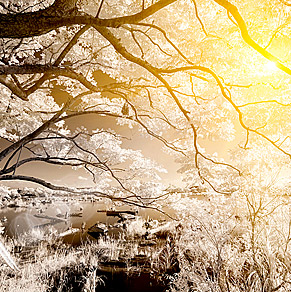
Our customers use digital infrared cameras for all sorts of applications, everything from landscape and wedding photography through medical and forensic photography. So if you are a photographer and looking for something new and unique to add to your photography arsenal then you came to the right place as digital infrared photography is truly beautiful, surreal and very unique. Here at Life Pixel Infrared we have converted thousands of digital cameras to infrared, using various infrared filters as well as our UV IR Visible conversion or simply the full spectrum conversion. So look around, browse our pages, view the sample infrared photos, our new infrared Photoshop tutorials and order your infrared conversion today.
Or on the other hand if you are technically minded and are good with your hands, take a look at our do it yourself infrared conversion tutorials, perhaps you can convert to IR on your own. Just don’t forget to order the appropriate internal infrared filter for your DIY conversion.
Ultraviolet UV Photography
It’s been long in the making but we have finally posted the UV Photography Gallery which includes photos and videos captured in ultraviolet light. Be sure to take a look at this strange world of UV light photography.
NDVI Camera Conversion
Yes, we can convert your digital camera for NDVI vegetation stress/health UAV drone mapping. NDVI camera conversion enables the capture of blue, green and NIR (near infrared) regions of the electromagnetic spectrum and after software processing will show a crop stress/health map. This NDVI map can be used to identify problem areas due to irrigation, fertilization, disease, etc.
With UAV drones becoming more popular and affordable farmers can now take advantage of this great technology to simplify their work and improve crop management. Once you have your camera converted to NDVI you can use Drone Deploy for your online drone flights and image analysis.
